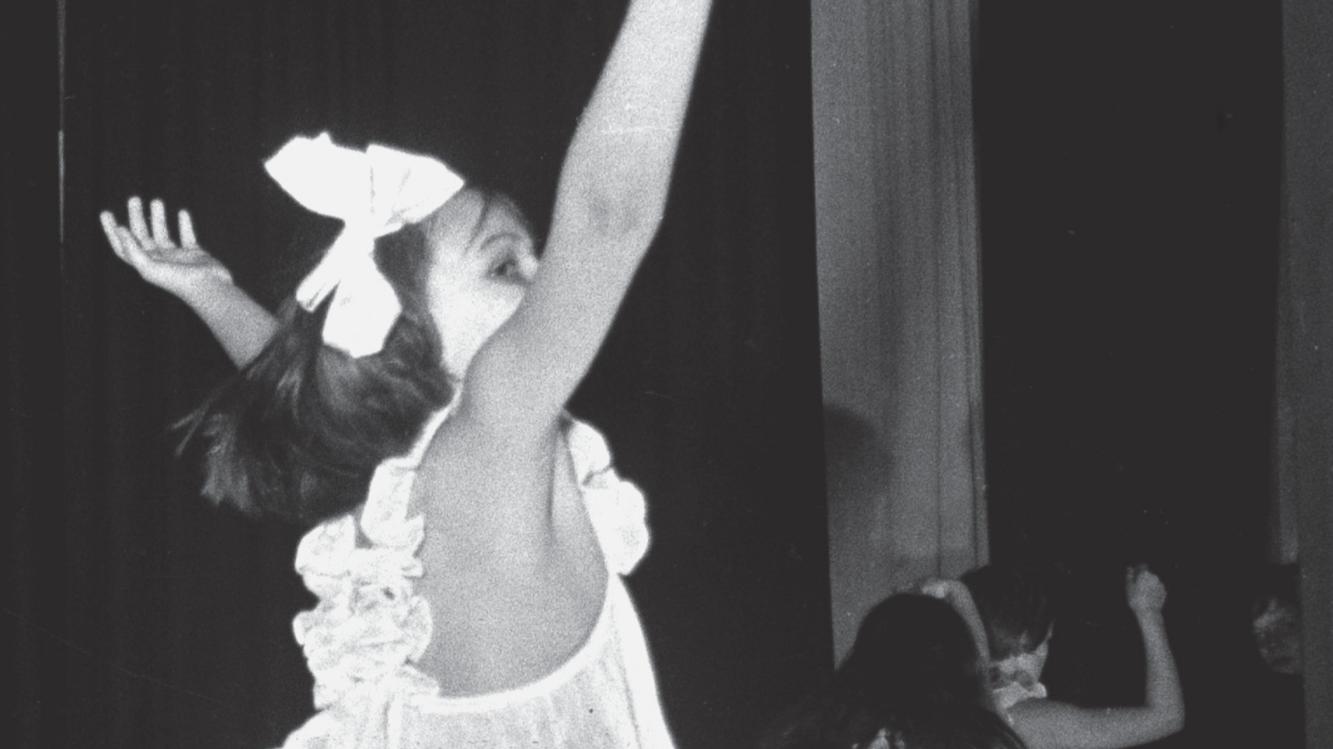
Lasten tanssiesitys todennäköisesti Elannon Iskun järjestämässä lasten joulujuhlassa [Børns danseoptræden under en julefest arrangeret af andelslauget Elanto]. Ukendt fotograf, 1954, Helsinki Bymuseum, Finna.fi. Billedet er frigivet til public domain.
English abstracts #90:
Tim van Gerven: “The Age of Severance is over”: The Scandinavists’ View of History and the Construction of the Pacifist North
This article examines the rise of Scandinavism and its contribution to the idea of a common Nordic identity, particularly with reference to the Uppsala student meeting of 1843. The article discusses how Scandinavists combined narratives of reconciliation and shared historical heritage to transcend past conflicts between the Nordic countries. These notions were supported by both historical fiction and poetic expressions that highlighted a common past and a set of shared values and interests. It also explores how conflicts were portrayed as deviations from a natural state of harmony, partly through the identification of external enemies and the introduction of a social critique that challenged existing social hierarchies. The article also highlights how Scandinavist ideas contributed to constructing an image of a peaceful and egalitarian Nordic region that has shaped both political cooperation and national identity in the region long after the heyday of Scandinavianism.
Keywords: Scandinavism, historicism, the North, cultural memory, historical fiction.
Björn Johnsen: Young Scandinavia: A 19th Century Radical Scandinavist Movement
This article argues that there existed in the 1840s and 1850s a radical alternative to mainstream nationalist-liberal Scandinavism. By focusing on actors, networks, practices, and the circulation of ideas, it explores radicals’ imaginations across the region as a Scandinavian expression of the Young Europe-movements abroad, a Young Scandinavia. Their imagined Scandinavia was not a nationalist union, but one based on the principles of republicanism, social justice, and cosmopolitanism. Furthermore, it was part of a European-wide radical imaginary.
Keywords: 1848, Scandinavism, radicalism, republicanism, transnational networks.
Stefan Hjort: Antiquity’s Volcanic Return: Henrik Wergeland’s Civic Festival “To the Memory of the Forefathers”
On Michaelmas in 1834, the Norwegian romantic poet Henrik Wergeland holds the civic festival “To the Memory of the Forefathers” in Eidsvoll. The celebration includes music, a bonfire, and dancing. Standing on a burial mound, Wergeland holds a speech where he compares Norway’s new constitutional freedom with its ancient freedom. This article traces the festival’s republican motivations, the ways that Wergeland’s conception of Northern antiquity intersects with history writing, philology, Gothicism, and natural history, as well as resonances with his early cosmological poetry.
Keywords: Festival, republicanism, romanticism, cosmology, poetry.
Audun Mortensen: Korean Echoes: Transnationality in Scandinavian Adoption Literature (1996–2024)
This article examines how transnationality is represented and negotiated in Scandinavian adoption literature published between 1996 and 2024 by Korean adoptee authors in Norway, Sweden, and Denmark. Drawing on critical adoption studies and intellectual history, and employing a transnational perspective, the article analyzes six first-person texts that both reflect and challenge the dominant adoption narrative. The analysis shows how adoption as a one-way movement from country of origin to receiving country is both reinforced and destabilized through literary representations of transnationality as threatening, emergent, and obligating. Particular attention is paid to the motif of return and its significance for the negotiations of nationality, kinship, and belonging in the works. The article argues that adoption literature contributes to shifting the boundaries of what can be thought and articulated about national belonging in a Nordic welfare-state context.
Keywords: Nordic contemporary literature, transnational adoption, adoption literature, intellectual history, Nordic welfare state.
Marit Bergner: “I am Norwegian” – Henrik Steffens as a Norwegian Cultural Ambassador in Germany in the 19th Century
The Norwegian-born philosopher and writer Henrik Steffens (1773–1845) played a significant role in promoting Norwegian culture and nature in Germany during the 19th century. His efforts greatly influenced the German perception of Norway, shaping a romantic and idealized image that captivated the German imagination. Steffens spent most of his life in Prussia, where he actively participated in Germany's intellectual and cultural life. His unique position as a Norwegian living in Germany allowed him to serve as a bridge between the two cultures, introducing German audiences to the beauty, uniqueness, and political structures of his homeland. Steffens' literary writings, were instrumental in presenting Norway in a romantic light. His descriptions of Norway coincided with a broader shift in German attitudes towards nature. During this period, there was a growing admiration for Nordic nature and mythology, which aligned well with the romantic movement's emphasis on the sublime and the picturesque. Steffens' portrayals of Norway's grandiose landscapes and resilient people resonated with this cultural trend, making Norway a subject of fascination for German readers and travelers.
Keywords: Norway, Henrik Steffens, novels; the North, identity.
Auksė Beatričė Katarskytė: The future is old. Three Victorian women travellers on Iceland
Iceland was a popular travel destination for late nineteenth-century British tourists, including numerous women. The focus of this article are three Victorian writers – Jane Elizabeth Oswald, Ethel Brilliana Tweedie og Mary Charlotte Gordon Leith (Mrs Disney Leith) – whose descriptions of Iceland combine fascination with the country’s past with their own visions for the future. Iceland is portrayed as frozen in time, a country where female travellers can experience a pre-modern, simple existence in harmony with nature free from the confines of Victorian gender norms. Contemporary Iceland is portrayed as unchanged since the Old Norse period – a democratic, heroic era characterised by high respect for women. By observing the alleged freedom of Icelandic women, which they trace to a romanticised past, they formulate their own hopes for the future. While Oswald and Tweedie wish for better possibilities for women in their home country, Leith imagines a dream future for Iceland free from progress. Leith’s vision is of a peaceful, introvert and feminine future protecting Iceland and herself against an all-consuming modernity.
Keywords: Icelandic travel, Old Norse, Victorian literature, women travellers, New Woman.